
On January 12, 2026, India’s space ambitions took center stage as the Indian Space Research Organisation (ISRO) launched its first major mission of the year — the PSLV-C62 / EOS-N1 mission — from the Satish Dhawan Space Centre in Sri hari kota.
Hailed as the 64th flight of the trusted Polar Satellite Launch Vehicle (PSLV), the mission was designed to carry a powerful Earth-observation satellite along with a constellation of co-passenger payloads for both domestic and international users.
📡 A Mission Designed for Earth Observation & Innovation
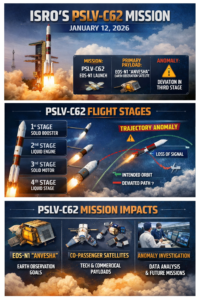
The PSLV-C62 mission carried EOS-N1, also known as Anvesha — a hyperspectral Earth observation satellite developed to support applications such as agriculture monitoring, urban planning, environmental assessment, and defence surveillance.
Alongside EOS-N1, the flight included multiple co-passenger satellites from startup and research institutions, making it a significant commercial launch under New Space India Limited (NSIL), ISRO’s commercial arm.
PSLV rockets, known for their reliability, use a four-stage design with alternating solid and liquid propulsion systems and have been the backbone of India’s satellite deployment efforts for decades’
🚀 The Launch — Excitement Followed by Uncertainty
At 10:17 AM IST, the PSLV-C62 lifted off in brilliant fashion, marking a moment of national pride and global attention as India kicked off its space calendar for 2026.
The initial stages of flight performed smoothly, capturing viewers’ imaginations as the rocket climbed skyward.
However, the mission encountered a critical issue near the end of the third stage (PS3) of the rocket’s flight.
Engineers observed a disturbance in the vehicle’s roll rates followed by a deviation from the intended flight path — a sign that something had gone wrong during that critical phase of propulsion. Within minutes, confirmations faded that the satellites were successfully injected into their intended orbit.
⚠️ Anomaly and Analysis
Following the deviation, ISRO publicly stated that the PSLV-C62 mission encountered an anomaly and that a detailed technical analysis of flight data has been initiated to pinpoint the cause. Officials have not yet confirmed the status of the payloads, while telemetry analysis continues.
This outcome comes just months after a similar third-stage deviation in the PSLV-C61 mission in 2025, raising questions about repeated challenges during this phase of the PSLV program
📉 What This Means for India’s Space Program
While the launch began as a showcase of India’s space prowess, the anomaly underscores the inherent risks of spaceflight — even for vehicles with strong track records. For decades, the PSLV system has been one of ISRO’s most dependable launchers, responsible for notable missions including Chandrayaan-1, the Mars Orbiter Mission, and Aditya-L1.
The recent setbacks now place additional emphasis on:
-
Engineering analysis and fixes to prevent future repeat issues,
-
Robust failure investigation mechanisms, and
-
Continued innovation and testing of advanced technologies.
🚀 What Was the PSLV-C62 Mission?
-
The PSLV (Polar Satellite Launch Vehicle) is ISRO’s reliable workhorse rocket, responsible for many of India’s successful satellite deployments.
-
PSLV-C62 was planned as the 64th flight of the PSLV series, carrying EOS-N1 (also called Anvesha) — a hyperspectral Earth observation satellite — along with multiple co-passenger satellites from startups, universities, and international partners.
-
The launch was significant as it involved hybrid objectives, including Earth observation for strategic and civilian use, technology demonstrations, and private sector payloads.
🛰️ Payload Details
Primary Satellite
-
EOS-N1 / Anvesha:
A hyperspectral imaging satellite developed for advanced Earth observation applications such as agriculture, environmental monitoring, urban mapping, and strategic surveillance.
Other Payloads
-
The mission included a collection of 14–18 ride-share satellites from Indian startups, academic groups, and international partners — testing technologies like in-orbit AI processing, communication demonstrations, and even on-orbit refueling experiment
📡 Launch & Anomaly
-
Launch Date & Time: January 12, 2026, at ~10:17–10:18 IST.
-
The PSLV-C62 lifted off successfully, with initial stages performing nominally.
-
However, shortly after the third stage (PS3) of the rocket, an anomaly occurred — causing the vehicle to deviate from its intended trajectory.
-
Initial reports indicate that this could result in the loss of the satellites aboard as they may not have reached their correct orbits.
🧪 Why It Matters
Technology and Innovation
-
The mission was designed not just to launch satellites but to demonstrate advanced space capabilities, including collaboration with private aerospace startups and international partners.
-
Components like on-orbit refueling experiments and AI-processing payloads represent the future of satellite operations — reducing costs and extending satellite life.
Strategic Importance
-
EOS-N1 (Anvesha) was intended to boost national capabilities in Earth observation and surveillance — benefiting areas like agriculture management, disaster response, resource monitoring, urban planning, and security.
Context in PSLV History
-
PSLV has historically been one of ISRO’s most successful launch vehicles with a strong track record. Recent back-to-back anomalies raise important discussions about reliability and technical troubleshooting for future missions.

🛰️ The Broader Impact
Beyond the technical challenges, the PSLV-C62 mission represented a valuable collaboration between ISRO and the private space ecosystem, as well as international partners. The co-passenger payloads included startup-led experiments and commercial satellites, showcasing how India’s space industry is expanding beyond government missions into global markets.
Even though the outcome remains under review, the mission adds to the ongoing learning curve for India’s space efforts. Setbacks like these — while disappointing — often fuel deeper insights, engineering improvements, and heightened resilience in future missions.
✨ Conclusion
The PSLV-C62 mission of January 12, 2026, began with high hopes and delivered valuable lessons. India’s space program continues to evolve, blending tradition with innovation and opening doors for private collaboration. As ISRO analyzes what went wrong during the third stage of flight, the world watches — knowing that each mission, successful or not, pushes the boundaries of possibility.